By J. Irving
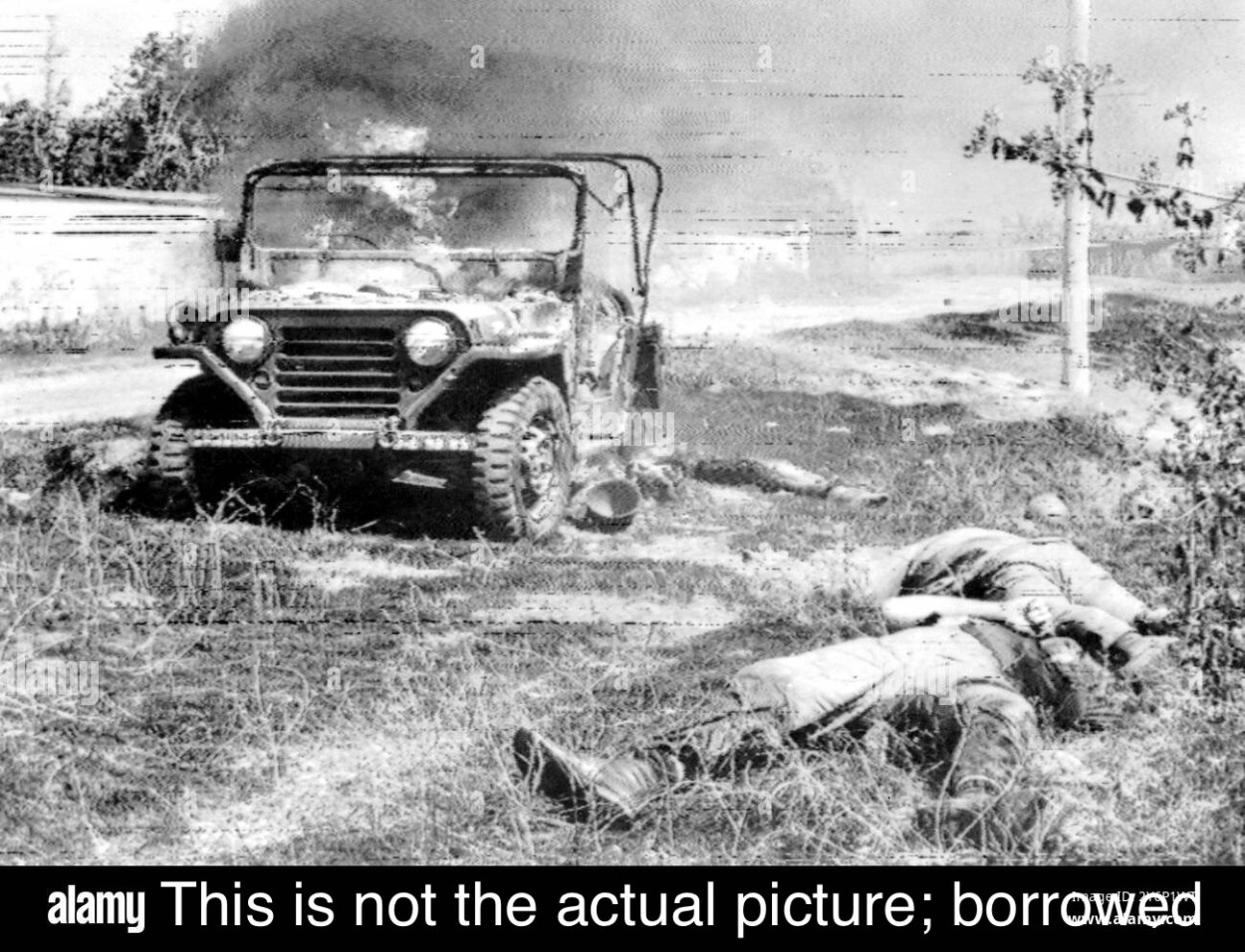
The jeep’s headlights remained unlit, as the vehicle cutting through the thick tropical silhouettes, starting to get dark, bouncing along the dirt road, winding through coconut groves and dense underbrush on the outskirts of Jolo town, towards Tandiong Beach, the the home of the returning soldiers – at the 4th Infantry “Scorpion” Battalion, deep in the southside of Mount Tumatangis, the highest peak in Jolo Island. The air was heavy with humidity, and the only sound was the soft rumble of the engine. Inside the vehicle were five Army personnel, returning from Asturias Hospital after Second Lieutenant (2LT) Ruperto Naparan ’79 visited the nurses at their quarters, a break from his battle anxieties. He extended his stay and took life (from the directive of the Division that there will be no movements at nighttime).
“Take life!” is a cadet lingo for taking the risk from getting caught in breaking a rule. But this time, it was the real sense of the word.
The passengers were all alert, not complacent, even they had trod the route several times already, to include nighttime, without any incident happening.
During daytime, route-securities were placed every 200 meters, daily, with a squad-strong but withdrawn before sunset.
What the route-security didn’t know that time, they still had troopers coming home; and a kilometer ahead, in a sharp bend by a dry creek bed, several MNLF Tausug fighters were getting in position. They had been monitoring Army movement for days and chose that bend for its natural choke point and low visibility.
As the vehicle approached, one shot aimed at the driver rang, a signal to commence firing. Suddenly, the night lit up.
A burst of M14 and M16 fire from the left embankment shattered the whole windshield. The driver slumped forward, the jeep veering off the road and coming to a halt in the underbrush. Some of the men at the back of the jeep managed to return fire with their Armalites but the rebels had the high ground and the advantage of surprise. Within a minute, it was over. All five soldiers were killed, in an instant, to include Lieutenant Naparan who was sitting infront.
This is how deadly and surely targets in an ambush are finished at an instant. Total annihilation and with no mercy!
Before disappearing into the darkness, the MNLF fighters stripped the bodies of weapons, ammunition, and radios. They left the jeep smoking.
This is how the ambuscade was described in detail by Lieutenant Danny Lim ‘79, a West Pointer who replaced Lieutenant Dick Morales ‘77 as commander of the FRU (First Reconnaissance Unit, totally composed of Igorot fighters) where my classmates and I were being acclimatized for field duty. as per instruction of General Luga ‘54, the Tabak Division Commander who did not want our class to suffer the same fate with class ‘79 of losing two officers.
For my testimony, I accompanied Lieutenant Colonel Ed Pangan ‘68, my battalion commander, at Jolo town to attend a party; but with pure intention of staying overnight at his advance command post (ACP) inside the Division Headquarters in Camp Bautista; with a plan to leave by daybreak when route-security was in place.
Plan-A was not followed. We left the party at around 8 o’clock that night and while we were walking towards our ride, my battalion commander told me that we would be going home, “Uwi tayo!” I pleaded with him dearly that it is too dangerous! There was a scheduled cockfight coming that weekend and the probability of an ambush was too high! As former G2 (Intelligence), he knew this. Perhaps his hasty decision was being affected by the drink he had; and for me, it was a consolation that he would be with me during the trip. So, I told him, “Anyway, kasama naman po kayo!”
For me, ambuscades in Jolo are not really strategic actions for a bigger end purpose of winning the conflict; but for “instant money”. By selling the firearms they found from ambush, they can immediately have gambling money. If they lost, they will resort again on ambuscades, repeating the cycle.
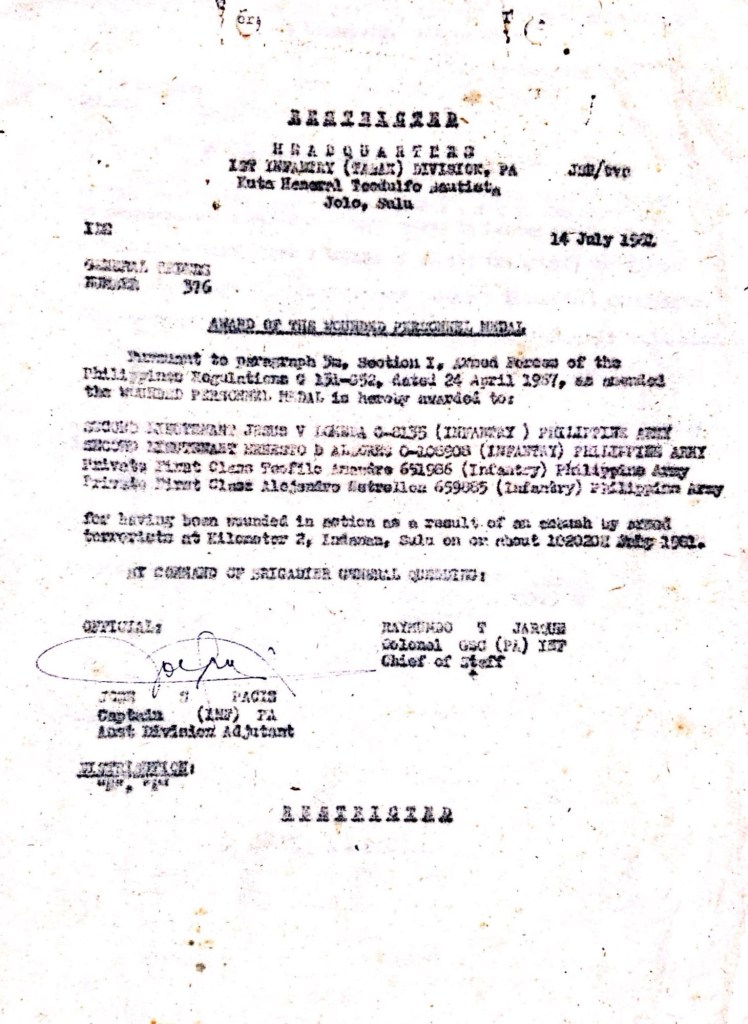
Colonel Pangan boarded his jeep, a Kennedy type. The rest of us, seven to be exact and to include my new company Ex-O, 2LT Ernesto Albores went with me, in a Toyota mini cruiser with an open back (no spare tire hanging). My Ex-O sat beside me infront, between me and the driver. Four stayed at the back.
LOCK AND LOAD! I got the M16 of the driver with a 30-round magazine. Our three security escorts had their long firearms, one of them an improvised 70-round magazine and 2LT Jimbo Ollero was holding his own cal.30 M2 Carbine, with a 30-round. Firearms pointing outwards. We were ready…
I thought my mini cruiser would spearhead the convoy but the Kennedy jeep, with 5 passengers, darted ahead.
At the crossing towards Tandiong and Tagbak, we turned left and from the asphalt road, we mounted a concrete cemented portion of the road at Kilometer #2 marker. The Kennedy jeep turned off its headlights. We followed suit. The moon was bright. I can see the silhouette of the Kennedy jeep infront of us. I made the sign of the cross and started praying my Rosary. I was in the first sorrowful mystery when a very long flashes of light at our left side began bursting intermittently.
AMBUSH LEFT! The Kennedy jeep, infront of us, broke through the ambush zone and sped away. We were left behind, exactly inside the killing-zone. Perhaps, the enemy probably thought that Colonel Pangan was on the second vehicle. We were able to return fire immediately. I swung my M16 infront of 2LT Albores and the driver, aligning the muzzle with the flashing lights. With one squeeze of the trigger, I emptied the 30-round magazine. Some empty shells from my armalite going inside the shirt breast pocket of Lieutenant Albores. I saw the windshield shattering in slow motion; and experienced seeing my whole life flashed before my eyes. I saw my mother. Then, our jeep swerved towards the direction of the ambushers. I fell when I was nudged by Lieutenant Albores to jump. I was able to distance myself away from the vehicle. I ran straight on top of the road pavement, as fast as I could, like a moving target on a shooting gallery in a carnival. I could hear bullets whizzing from left to right passed by all over me. My rifle was empty. I remembered the ammo bandolier was left hanging at the backrest of the driver seat. I was thinking of throwing away the rifle because this was the only thing the enemy wanted; but I decided not – to frustrate them. I did not know if I’m already dead and this was my soul running away from my body?
How do I die? What is the feeling of death? Maybe not yet, I can feel myself. I’m not seeing the scene in a top view position, with my perspective floating away from the picture. Then my leg gave way. I rolled and fell off-road into the bushes, newly cut talahib grasses. Then suddenly, the driver crawled towards me. I was about to shoot him with my cal.32 pistol coming from the right pocket of my pants. The driver whispered that I have to take off my white T-shirt, quick. Returning his empty rifle, I moved slowly and quietly removed my shirt. There was silence but I could hear my heart pounding, controlling my breathing, keeping my head on the ground, faced down. If I feel something from behind, I would shoot it immediately with my pistol and then shoot myself. I won’t be held captive and beheaded.
My companion told me to run towards the detachment of the 18th Infantry Battalion (18IB), more than 100 meters away infront of us.
Why did my battalion commander sped away and did not seek help there? The group surely thought we were all dead by that instant, useless to dismount and fight in the dark; and Sergeant Cristi, with the group, insisted to get stronger reenforcement from the battalion headquarters.
I told the driver not to move because the friendly troops might be the one to shoot us. Troops from the detachment were also able to fire back towards the enemy during the exchange of gunfire. My driver and I could hear the enemy reloading their firearms. My driver said that they were about to burn the vehicle and pouring gasoline. The area became bright and they were searching. I froze. I was too afraid to move. Perhaps, the enemies were hesitant to approach us because it was towards the direction of the detachment …
Waiting for reinforcement from my battalion commander seemed like eternity. It never arrived. This is it! My end is near. My left leg was bleeding. I cannot fight back because I have no more ammo. I held on to my Rosary . . . my only refuge!
Then I heard voices, Ilocano voices, not Tausug. I recognized the voice. My Guardian Angel! First Lieutenant (1LT) Johnny Corcha ‘77, a highlander and a tribal leader of Igorots, was barking orders in a hushed tone, “Jai de banger!” (It means, “At the other side” in Ilocano). It was only at this time I raised my right arm, “Andito kami!” Soldiers picked us up. A ¼ ton truck arrived and we, all the seven of us, were brought to Camp Asturias Jolo Station Hospital for treatment.
My mistahs heard the news of the ongoing firefight from their respective radio rooms. 2LT Ricardo Pasamba ‘80 of 18IB, the guardian of Jolo Town, alerted his team and got ready to reenforce . . .
At the hospital, my shrapnel wounds were treated without removing the metals inside my legs. All my wounded companion had leg injuries. The enemies hidden behind big boulders (as I visited the site on a safe day) were aiming low, perhaps because of our returning fire. I presumed the bullets coming from us ricocheting in the big rocks. The enemy chose a wrong place, they had to seek cover. It was a miracle! Nobody died and no firearms were taken from us.
The following day, a mistah was confined at the hospital and his designated bed was the next one at my left. 2LT Rustico Francisco ‘80 was admitted for malaria. In fact the Falciparum type, the most dangerous form. Then, I felt safe and happy that a mistah was there at the hospital ward to sympathize with me . . .
After a couple of days at the hospital, I demanded to be released and continued my recuperation at the battalion headquarters. The battalion headquarters was located along the way in going to the 1/3 Brigade Headquarters, which is located on top of Bud Datu, where the homebase of the legendary battle-hardened COLONEL RODOLFO CANIESO ‘56 was entrenched.
So one time, then Colonel Canieso ‘56 dropped by to see my battalion commander, Colonel Pangan. In front of him, Canieso asked me in jest, “Man, meron ka bang anting-anting?” (Man, do you have an amulet?) This was because he knew how severe ambuscades are, in Jolo.
As rumoured, Colonel Canieso, an Ilonggo, believed in anting-anting. He didn’t take a bath on a Friday and we frequently see his Kennedy jeep early morning pass by our posts with only a driver and a radioman – when route-securities were not set up yet. As company commander of Alfa Company, he would stop at my post and tell me, “Do not let Usman Sali die of old age!” (the MNLF Kumander who led the massacre of General Bautista ‘52 and staffs).
When asked about the anting-anting, I only smiled while I held into my Rosary in my right-side pocket of my BDA pants, without taking it out or showing it to him …
 patamassacre.data.blog